Great Depression
The Boys in the BoatThe Great Depression is the book’s encompassing economic crisis and a force that repeatedly narrows the choices available to its characters. Its effects appear at different scales: a national collapse in employment and savings, the disappearance of income from a farm in Sequim, the struggle to pay for college, and the question of whether a working-class crew can afford to reach Berlin. The crisis gives the team’s athletic hopes a practical urgency: rowing offers Joe Rantz a possible route through school, but even success cannot guarantee that the money to continue will be there.
Scale and Uncertainty
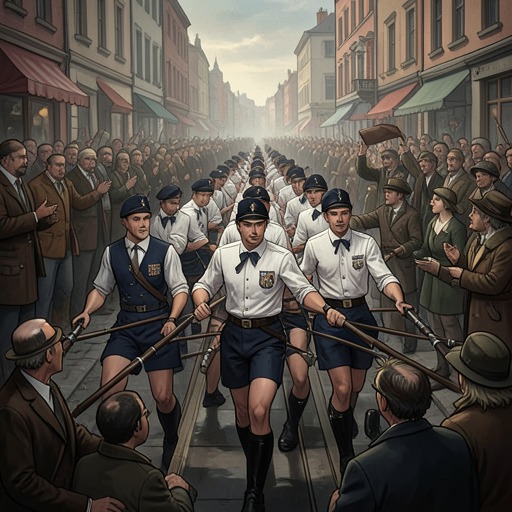
The opening places the reader in Seattle rowing and labor-conflict city on October 9, 1933, amid the Depression’s fourth year. The book sets ordinary urban life against the scarcity surrounding it: people sold fruit and gum from carts, while others waited for soup kitchens to open. Along the waterfront, work had dwindled; fishing boats sat unused, and shipyards were nearly abandoned. These local details give physical shape to a crisis that had left one in four working Americans—ten million people—without jobs or prospects, while only a quarter of them received relief. At least one million people, and perhaps as many as two million, were homeless, including residents of Seattle Hooverville.
The crisis is presented not only as deprivation but as prolonged uncertainty. Industrial production had fallen by half; bank failures had erased family savings, and nobody knew when the hard times would end. A sharp one-day rise in the stock market in March 1933 offered a glimmer of recovery, but it could not restore savings held in failed banks or reassure households with little or no investment in shares. The book notes that the Dow Jones Industrial Average would not regain its previous high until 1954. The gap between a financial indicator’s rebound and families’ daily circumstances is central to its account of the period.
Political optimism does not resolve that uncertainty. Franklin D. Roosevelt entered office promising programs and action, but the book recalls that Herbert Hoover had also spoken confidently about ending poverty. The memory of such assurances, set beside continuing hardship, makes recovery feel uncertain rather than assured. Even popular culture registers the atmosphere: King Kong, released in 1933, drew large audiences with a story of people caught in the grip of a destructive force. The book connects that appeal to a public accustomed to fearing that the ground could disappear beneath them.
The Crisis Reaches the Rantz Family
The economic collapse reaches the Rantz household in Sequim after the Wall Street Crash of 1929. Farm prices were already under pressure from large surpluses of wheat, corn, milk, pork, and beef. Wheat brought only a tenth of its earlier price, and in Iowa corn sold for less than a packet of gum. The rural economy in Sequim had not yet reached the depths of the Great Plains, but the Rantz farm was barely profitable. When Harry Rantz and Thula Rantz read the news of the crash in the Sequim Press on October 30, they recognized that their relative distance from financial centers would not protect them.
The crisis becomes immediate through losses in farm income. Families leaving their homes and farms abandoned dogs, which began chasing the Rantz cattle. The cows’ milk, the farm’s principal cash product, fell away as they were driven about and exhausted. Minks then killed chickens, diminishing the money the family received from eggs. These events are not separate from the larger downturn: they compound a farm already exposed to collapsing prices, removing the small sources of income on which the household depended.
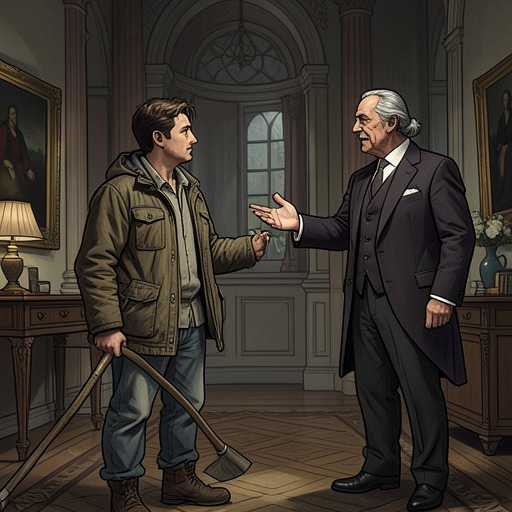
Joe Rantz responds by trying to feed himself and find cash. He gathered mushrooms, berries, watercress, and fish, and fortified the chicken coop against further attacks. But foraging could not meet every need. He drove his father’s old Franklin into town, parked on Washington Street, and played banjo and sang from its hood in the hope of earning money. The attempt brought little; the State Bank of Sequim would fail within months, storefronts were being boarded up, and the town offered almost no audience or work. The Depression thus appears not as an abstract national statistic but as a condition in which even a resourceful person’s small efforts could produce no income.
Work, Education, and Unequal Security
Years later, the same economic vulnerability shapes Joe’s prospects at the University of Washington. A place on the freshman crew would not provide a rowing scholarship, because none existed there in 1933. It could, however, guarantee him part-time campus work, which, together with the savings he had accumulated through manual labor, might make college possible. Failure to stay in school threatened more than a sporting disappointment: Joe feared losing the chance to become a chemical engineer and to build a life with Joyce Simdars. He associated that failure with returning to the Olympic Peninsula and trying to survive on odd jobs, foraging, or another Civilian Conservation Corps job.
The economic pressure also sharpens Joe’s awareness of class. In 1934, as he prepared to leave for Christmas, an article in The Daily reported that more than half the male students interviewed had their education paid for by parents or relatives who did not expect repayment. Its figures—an average graduate debt of two hundred dollars and an average four-year cost above two thousand—made the contrast concrete. Joe had assumed that a degree would open a more promising future; the report showed him that many students could pursue one without carrying the same financial burden. The discovery renewed his anxiety and added jealousy to his sense of being different from classmates whose families could support them.
That contrast also appears in the stories of other rowers. Johnny White’s father, John White Sr., had lost the business that exported scrap steel to Asia after the crash. He spent years waiting for work that never arrived, until he began growing food in the family’s lakeside garden. Johnny’s family survived through a combination of vegetables, fruit, chickens, eggs, and his mother’s small-scale trading and paid work. The Depression did not make every household’s circumstances identical: Chuck Day’s family, for example, remained relatively comfortable because his father’s dental practice continued to provide income. Their different backgrounds help explain why the danger of losing work or money weighs so heavily on Joe, even among teammates facing the same athletic demands.
From Local Hardship to National Upheaval
The book repeatedly places financial distress beside other pressures without treating them as interchangeable. As the country endured heat and drought, and labor conflict intensified along the West Coast, political arguments over Franklin D. Roosevelt’s policies grew sharper. The accounts of opposition to the New Deal underline the distance between improved stock-market figures or a slight rise in employment and the experience of Americans for whom hardship still seemed unchanged. The crisis is therefore not presented as a single statistic with a clear endpoint; its consequences overlap with disputes about work, public assistance, and the country’s direction.
The Dust Bowl renewed the pressure to move west. After the devastating dust storm of April 14, migration that had been a trickle became a torrent; within a few years, two and a half million Americans would leave in search of a place to live and work. Newspapers described the Northwest as a promised destination, and agencies in Seattle rowing and labor-conflict city received inquiries about any available job from as far away as Missouri and Arkansas. Yet the apparent opportunity concealed its own obstacles. Cheap acreage near Puget Sound could contain hundreds of stumps per acre, hard-packed glacial soil, and a cool, gray climate poorly suited to crops familiar to Midwestern farmers. The book’s contrast between recruitment and reality shows how economic desperation could make uncertain prospects appear like refuge.
The Crisis Inside the Crew’s Ambition
For Joe, rowing offers purpose and a possible path to an education, but it does not remove economic precarity. At Grand Coulee, after a season in which coaches had demoted and promoted him repeatedly, he was broke and discouraged. The prospect of Olympic gold had become personally important, yet reaching Berlin depended on making the varsity crew, and staying at school depended on finding the money to return. His dangerous summer work drilling rock with a jackhammer was part of that chain of dependencies: earning enough to continue rowing and studying came before the possibility of competing abroad.
The same constraint returns after the Washington crew’s victory in the East. The American Olympic Committee faced a shortage of funds, and the Washington rowers were told that they might have to pay their own way to Berlin. The demand was especially severe because they were working-class students, not heirs who could readily contribute the fare. Al Ulbrickson was told that five thousand dollars had to be raised by the end of the week or Pennsylvania could take Washington’s place. He and others moved quickly to organize support in Seattle rowing and labor-conflict city, while keeping the funding crisis from the athletes as long as possible. Their success on the water had not settled the question of whether they could afford to race.
Across these episodes, the Depression is a recurring test of whether talent and effort can be converted into security. For Joe, work, food, school, and the crew are linked; for the Washington rowers, victory does not itself pay the cost of travel. The book gives the crisis no simple resolution in these passages. Instead, it shows how ambition must be pursued amid failed markets, scarce jobs, unequal family resources, and the continuing possibility that money will close a door just as it appears within reach.